
Core Rules is a complete Linux, Windows 11 and macOS version of AD&D Core Rules 2.0 and its Expansion (TSR, 1998 and 1999), the character manager and Dungeon Master's toolkit for Advanced Dungeons & Dragons 2nd Edition. It is written in Rust and runs natively on all three systems, with no Wine.
Why it exists
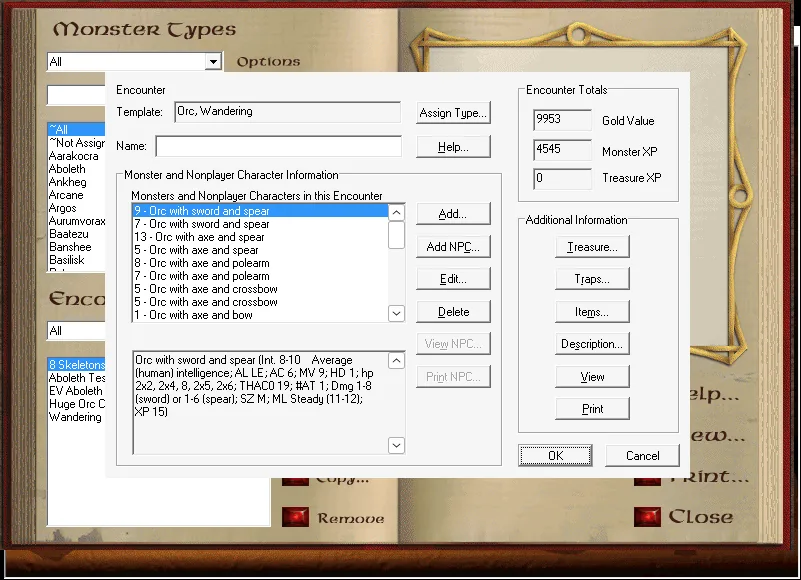
In 1998, a box arrived with a CD inside and a promise on the cover: every rule of Advanced Dungeons & Dragons in one program. AD&D Core Rules 2.0, and a year later its Expansion, rolled our characters, filled the sheets, built encounters, counted treasure and kept the books a click away. For a whole generation of players it was the closest thing to magic a beige PC could do.
Then the years passed. Windows changed, the installer stopped working, and the discs went to a shelf.
Not long ago I wanted to play AD&D again with my friends. We had grown used to the comforts that D&D Beyond gives the fifth edition: characters made in minutes, sheets that do the math, everything in one place. Second edition deserved the same. And I already owned the original discs of Core Rules 2.0 and the Expansion. I just couldn't use them.
So I decided to port it to our times. Not a new program that merely remembers the old one, but the same program: every screen, every table, every roll, reading and writing the very files the original wrote, so a character made in 1999 opens today and a character made today opens in 1999.
What it does
- Character Generator: creating and editing characters under the core rules or Player's Option, with kits, proficiencies, spells, psionics, equipment, portraits and levels.
- Character sheet: printed, saved as PDF or exported as TXT, HTML and Markdown; the TXT and HTML exports match the original's line for line.
- DM Toolkit: NPC, treasure and encounter generators, rolls on the books' tables, and editors for every user database.
- Books and help: the rule books in a reader with contents and search, and the CD's help, which Windows 11 and Linux cannot open, in its own window.
- Six interface languages: English, Brazilian Portuguese, Spanish, Italian, French and German. The original is in English only.
- Community add-ons: version 1.2.0 imports every add-on in a folder at once, and the collection of 672 community add-ons, converted to the Expansion's format, comes as a single
.zip.
The app contains no TSR or Wizards of the Coast content: the rules, books, monsters and pictures come from a copy of the original CD, which the app reads once and then no longer needs.
One version for each system
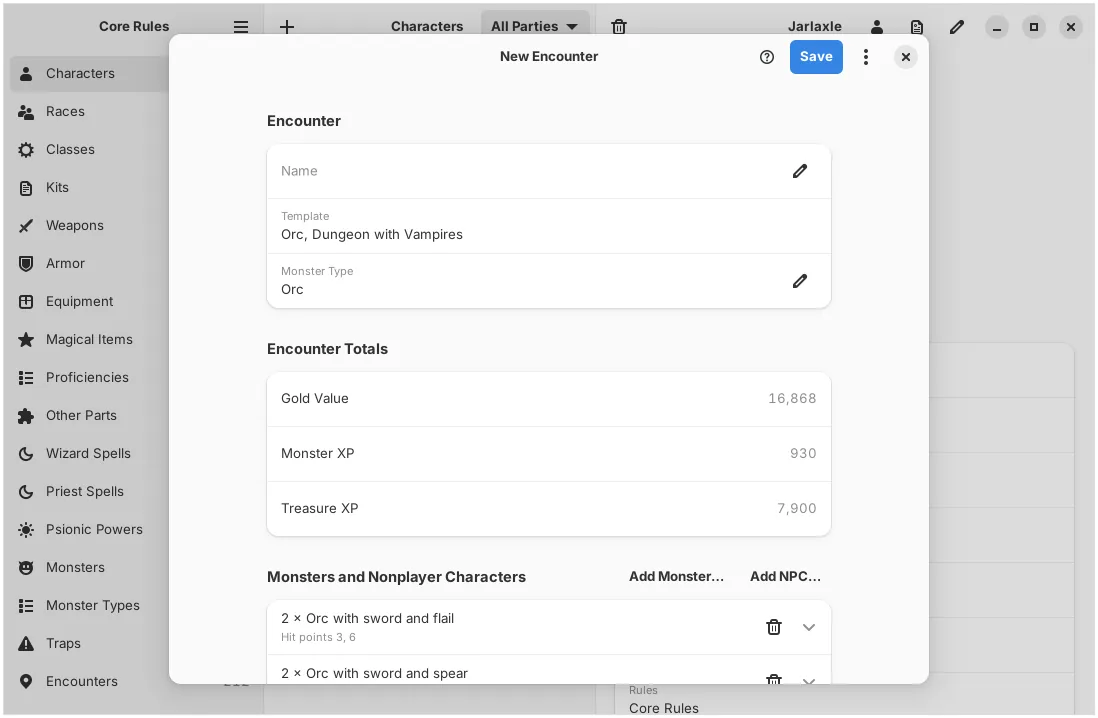
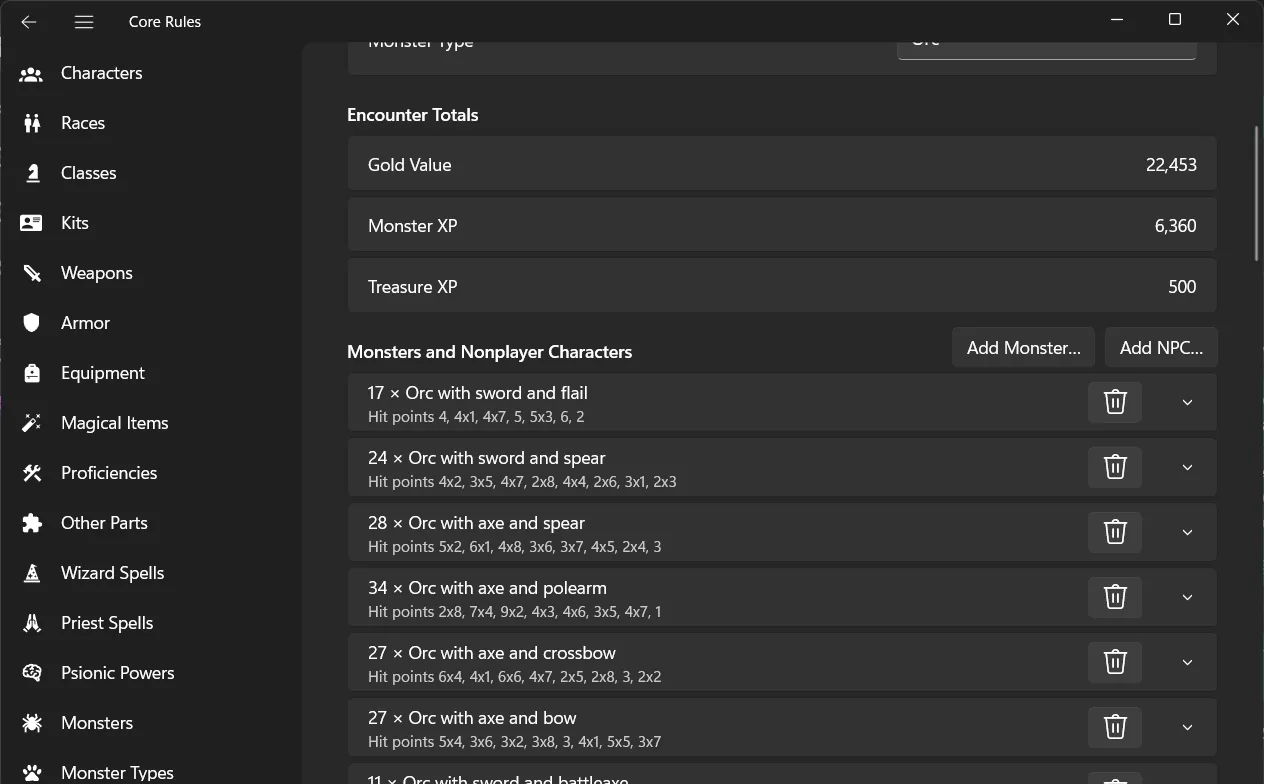
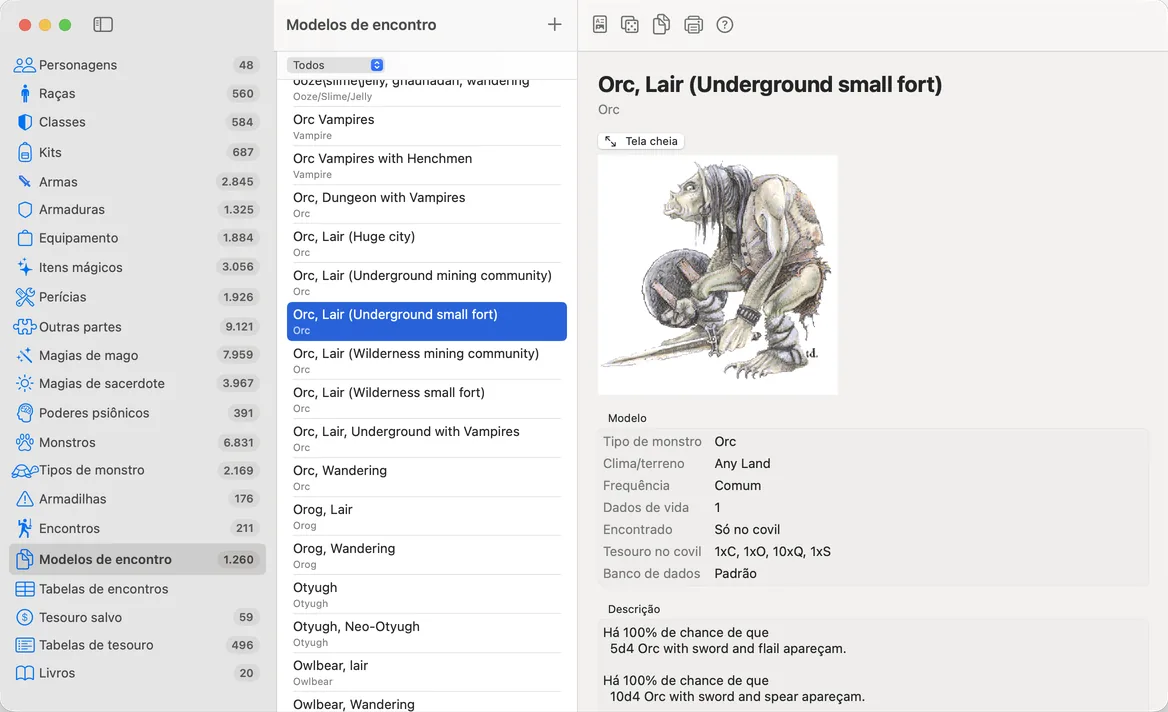
Each system has its own interface, built with its native tools, over the same Rust core and the same data files: GTK 4 and libadwaita on Linux, WinUI 3 on Windows 11 and SwiftUI on the Mac. Below, the encounter generator on all three.
How it was made
I design, specify, plan and review Core Rules, and Claude, Anthropic's AI, writes the code. The first commit is from October 9, 2026. Version 1.0.0, for Linux, came out on October 24, after user testing on Fedora, Ubuntu, Bazzite, Arch Linux and CachyOS. The Windows 11 version came with 1.0.1 on October 27, and the macOS one with 1.1.0 on October 29. Every feature was compared with what the original programs write. On Linux there are packages for Ubuntu, Fedora and Arch Linux (which also serve CachyOS and Omarchy), plus a Flatpak and an AppImage. On the Mac it runs on Apple Silicon models, and on Windows 11 it comes free from the Microsoft Store.
The code is under the MIT license. AD&D and Advanced Dungeons & Dragons are trademarks of Wizards of the Coast, and the project is not affiliated with it.